In this post
In an earlier post on Attack Flow, I focused on how the model works technically.
This post is about why procedures are the missing operational part of most TTP research.
ATT&CK gives us tactics and techniques.
What is often missing is procedure-level modelling: the concrete way a technique is executed in a real environment.
That gap is often the difference between “coverage on paper” and “defence in production.”
In this post we’ll cover:
- what technique mapping misses
- why procedures are the missing layer in TTP analysis
- what procedures add in real SOC workflows
- practical case studies that show the difference
- why Attack Flow is a good way to represent procedures in STIX-native environments
- a practical POC
Procedures: the missing part of TTPs
In theory, “TTPs” include tactics, techniques, and procedures.
In practice, many programs mostly model tactics and techniques.
That creates a blind spot.
A technique tells you a class of behavior.
A procedure tells you the exact operational implementation of that behavior:
- what command or API is used
- in what sequence
- against which assets
- under what conditions
- with what expected effect
Without procedures, ATT&CK mapping can become taxonomy without execution context.
With procedures, ATT&CK becomes operationally testable.
The coverage problem nobody likes to admit
Many teams have an ATT&CK heatmap that looks healthy.
PowerShell covered. Credential access covered. Lateral movement covered.
Then an incident lands and those same teams discover the painful gap: they covered categories, not execution paths.
This is the key distinction inside TTP work:
- Technique mapping tells you what an adversary can do.
- Procedure mapping tells you how they actually did it in your environment.
That “in your environment” part is the whole point.
Procedures include operational details that drive outcomes:
- sequence
- timing
- target asset class
- identity context
- command chains
- conditional branching
Without these, you can build a technically correct ATT&CK model that is still operationally weak.
What changes when teams move from techniques to procedures
Across CTI, detection, and response workflows, the same shift appears once teams move to procedure-level modelling.
1) Ransomware response becomes sequence-aware, not label-aware
During a ransomware intrusion, the difference is usually not whether “execution” or “impact” was covered in ATT&CK.
The difference is whether the team models and detects the actual chain, for example:
- WMI-triggered PowerShell
- shadow copy deletion command chain
- scheduled task deployment
- targeting backup systems during maintenance windows
When teams model this as a procedure, incident response can triage and contain based on path progression, not isolated alerts.
2) Threat intelligence triage focuses on novelty
At technique level, many reports look like repeats.
When procedures are extracted, teams can quickly separate:
- known procedure variants already covered
- truly new procedural behavior requiring engineering effort
This changes intelligence from “more reading” into a prioritization engine.
3) Detection engineering shifts from tool signatures to attacker outcomes
Tool-centric detections degrade as adversaries swap tooling.
Procedure-centric detections stay useful because they anchor on behavior:
- memory access patterns for credential access
- authentication and movement anomalies for lateral spread
- persistence state changes (e.g. tasking/autoruns) before impact
Detection strategy becomes: detect objective completion, regardless of utility used.
4) Risk decisions become concrete
Technique labels are often too broad for hard prioritization decisions.
Procedure mappings make risk specific:
- which systems are targeted
- when they are targeted
- what attacker preconditions must be true
- what business process is disrupted if the chain succeeds
This gives leadership an evidence-backed basis for control investment.
5) Adversary emulation validates realistic paths
Technique checklist exercises are useful, but often too generic.
Procedure-led emulation tests realistic operational chains end-to-end, which improves:
- control validation fidelity
- speed of gap discovery
- quality of purple-team findings
The common pattern
Across all of these examples, the same thing keeps happening.
Technique-level mapping gives teams a useful taxonomy.
Procedure-level modelling gives them something operational:
- realistic prioritization
- honest visibility into coverage gaps
- detections that survive tool changes
- clearer links to business risk
- more realistic adversary emulation
That is the practical difference between a framework view of attacker behavior and a model you can actually use in production.
Why Attack Flow can help
If the problem is sequence and context, we need a model that captures sequence and context.
STIX itself does not have the concept of a Procedure object.
Attack Flow gives us that while staying STIX-native.
It lets us represent:
- ordered attack actions
- branching through conditions/operators
- command context through process objects
- target context through attack assets and linked STIX objects
Most importantly, it lets us represent procedure chains as first-class data objects, not analyst narrative fragments lost in PDFs or tickets.
That makes procedures queryable, testable, and reusable.
That is why Attack Flow is such a good fit here.
The case studies above all point to the same requirement: defenders need a way to represent not just what technique was used, but how the attack path actually unfolded.
Attack Flow gives us that without abandoning ATT&CK or leaving the STIX ecosystem.
A practical POC: procedure mapping with Attack Flow
Let’s make this concrete.
Model one high-impact ransomware procedure end-to-end in Attack Flow, then link it to detections, assets, and controls.
Procedure chain:
- WMI-triggered PowerShell
- shadow copy deletion
- scheduled task deployment
- backup server targeting during maintenance windows
Full flow view:
Step 1: WMI-triggered PowerShell execution
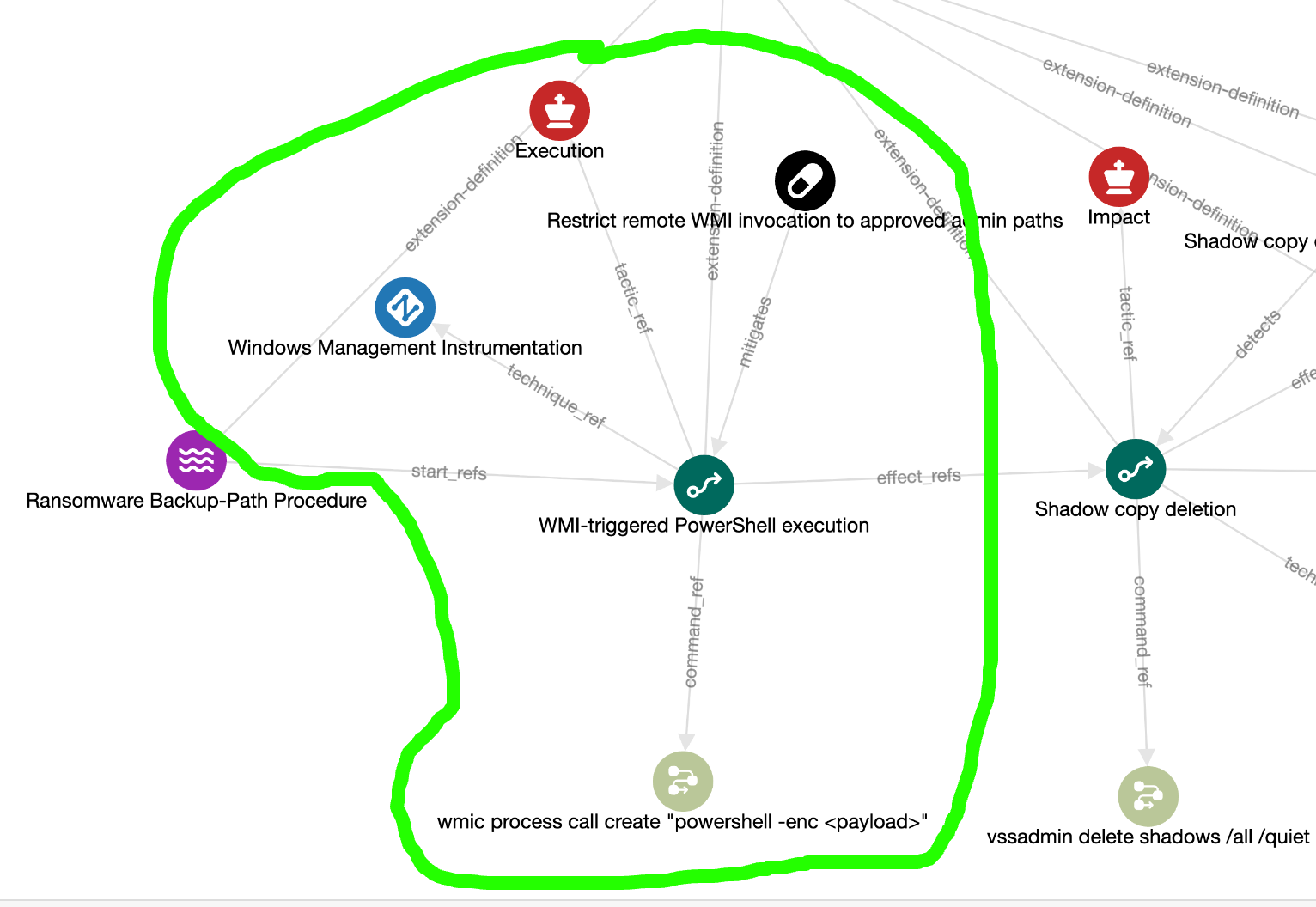
This action maps to ATT&CK Execution (TA0002) and WMI (T1047) and includes command context via a STIX process object.
Step 2: Shadow copy deletion
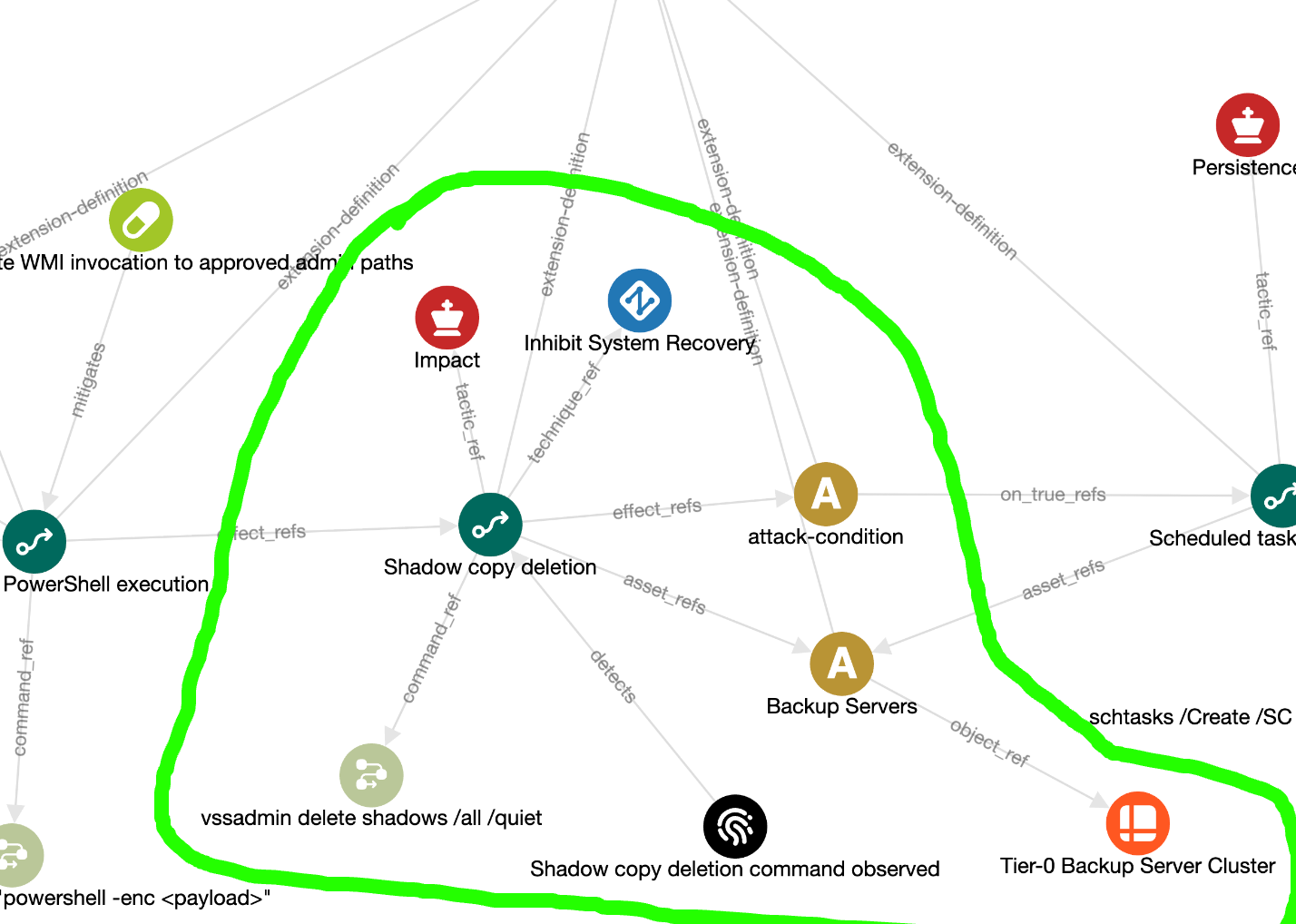
This maps to Impact (TA0040) and Inhibit System Recovery (T1490) and includes detection mapping via an indicator:
"pattern": "[process:command_line MATCHES '(?i).*vssadmin\\\\s+delete\\\\s+shadows.*']",
ICYMI: In my last post I showed how to link to Sigma Rules to Attack Flows.
It also links targeted assets (attack-asset) to core STIX infrastructure.
Step 3: condition-based progression to scheduled task deployment
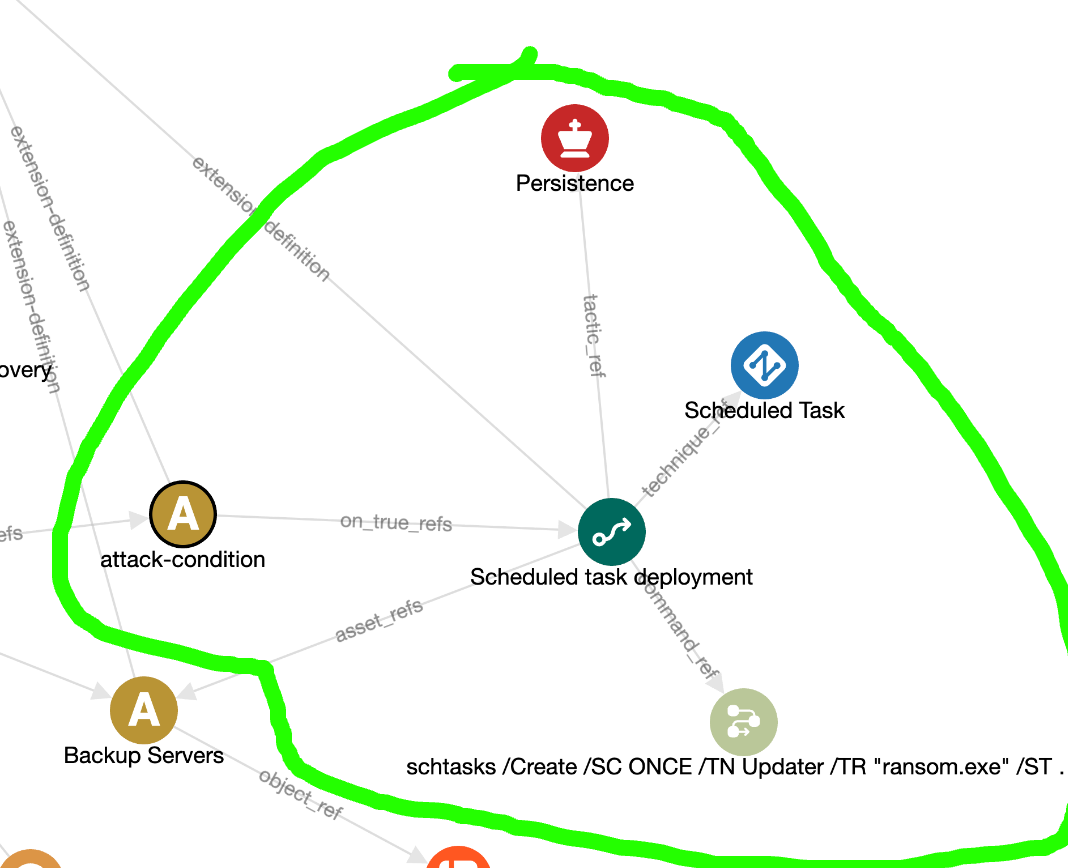
Between step 2 and step 3, an attack-condition captures attacker logic:
Target host is backup server AND operation occurs within maintenance window.
With this pattern, procedure modelling remains composable, standards-aligned, and portable across STIX-native tooling.
In summary
Tactics and techniques are essential, but incomplete on their own.
Procedures are the missing part of TTPs in many ATT&CK programs.
If your model cannot show how an attack path unfolds across sequence, conditions, assets, and controls, you are measuring taxonomy, not readiness.
Attack Flow gives us a practical way to close that gap without abandoning ATT&CK or STIX.
The immediate next step is simple: pick one high-impact procedure in your environment, model it end-to-end, and validate whether your detections and controls break the chain in practice.

Join the discussion
Head over to the dogesec community to discuss this post with other readers and practitioners.
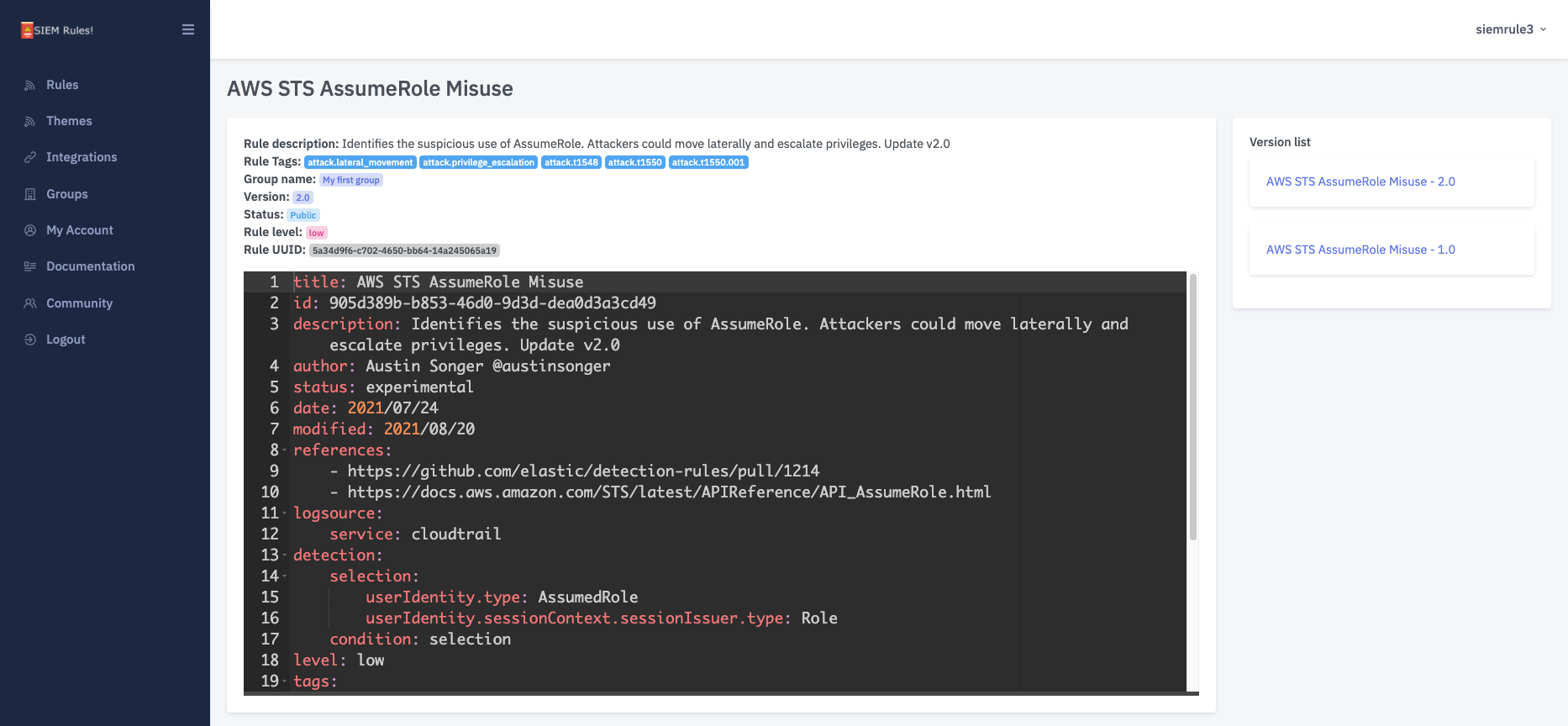
SIEM Rules
Your detection engineering AI assistant. Turn cyber threat intelligence research into highly-tuned detection rules.
CTI Butler
The most important cyber threat intelligence knowledgebases.
Open-Source Projects
All dogesec commercial products are built in-part from code-bases we have made available under permissive licenses.